Original: $5.30
-65%$5.30
$1.85The Story
Assorted Balloon Molly (Poecilia latipinna)
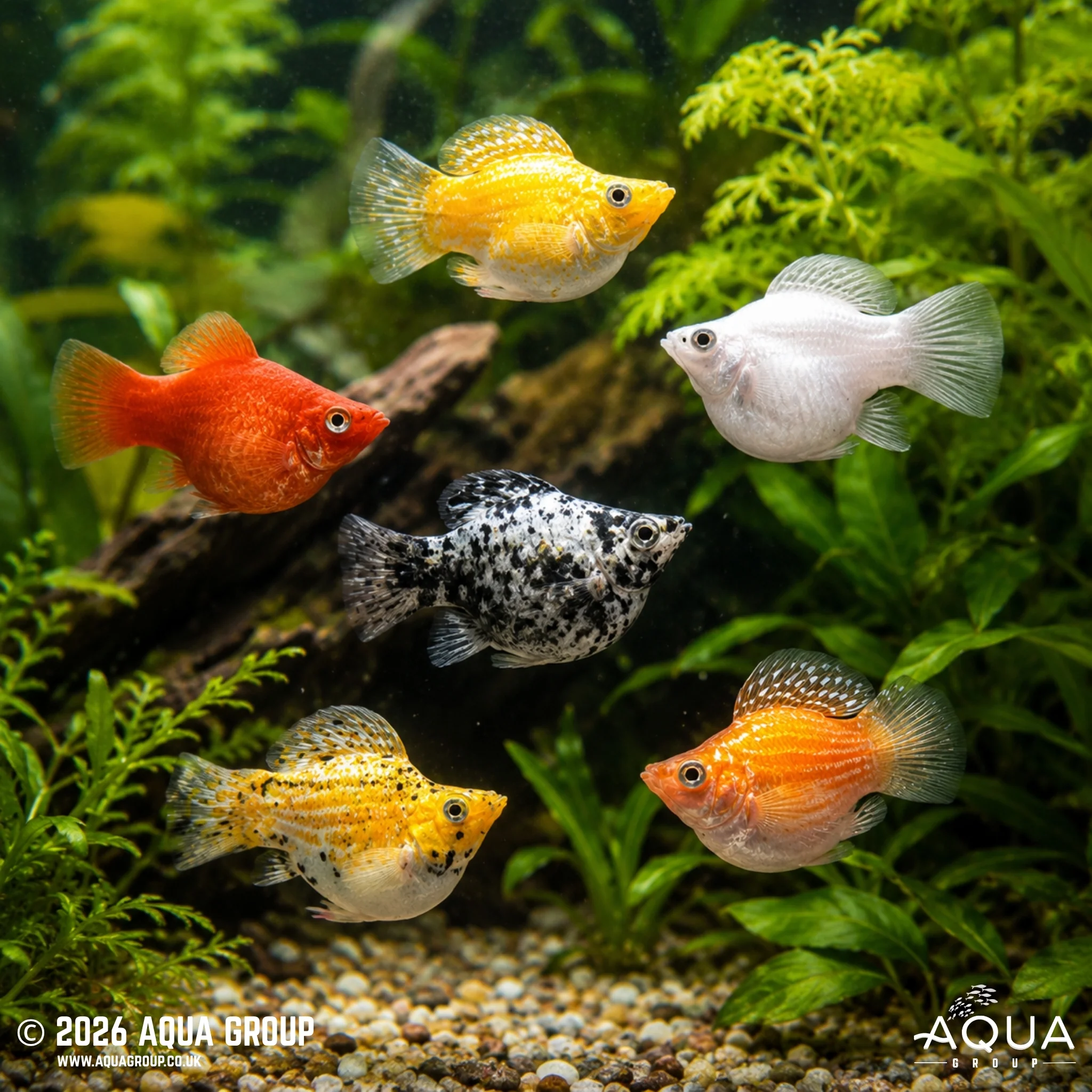
The Assorted Balloon Molly is a colourful captive-bred livebearer, popular for its rounded body shape, active behaviour and mixed colour patterns that may include black, white, gold, orange, dalmatian, marble and mixed markings. This fancy molly variety is best suited to clean, stable freshwater aquariums with moderately hard to hard, alkaline water. Peaceful, lively and easy to feed, it makes a bright addition to suitable community aquariums, but it should be kept in the correct mineral-rich water conditions for long-term health.
Common Name:
Assorted Balloon Molly. Also commonly referred to as Balloon Molly, Balloon Belly Molly, Fancy Balloon Molly, Assorted Molly or Balloon Sailfin Molly.
Scientific Name (Latin):
Poecilia latipinna
Maximum Size:
Around 5–8 cm in captivity for most balloon forms, although Sailfin Molly-type strains may grow larger depending on breeding line and body shape.
Water Type:
Freshwater
Can also tolerate lightly brackish conditions when acclimated correctly.
Origin / Natural Habitat:
The Assorted Balloon Molly is a captive-bred aquarium strain. The wild form of Poecilia latipinna is native to freshwater, brackish and coastal habitats from the south-eastern United States through to parts of Mexico. Wild Sailfin Mollies are found in warm still or gently flowing waters, ponds, lakes, sloughs, quiet vegetated backwaters, tidal ditches and brackish canals.
Water Parameters:
Temperature: 22–28°C
pH Range: 7.2–8.5
Hardness: moderately hard to hard water strongly preferred
Temperament:
Peaceful and active. Suitable for community aquariums with other calm fish that enjoy similar harder, alkaline water conditions. Males may chase females, so mixed-sex groups are best kept with more females than males.
Diet:
Omnivorous with a strong herbivorous grazing tendency. It should be offered a varied diet including quality flake, small pellets, spirulina, algae-based foods, blanched vegetables, daphnia, brineshrimp and occasional bloodworm. Algae and vegetable-based foods are especially useful for long-term molly health, as Poecilia latipinna naturally feeds heavily on algae alongside small animal foods.
Minimum Tank Size:
A practical recommendation is at least 80–120 litres for a small group, with larger aquariums preferred for long-term stability and mixed community setups.
Behaviour & Activity:
This is an active mid-to-upper level livebearer that spends much of the day swimming, grazing and exploring the aquarium. Females give birth to free-swimming fry, so numbers may increase quickly in a mixed-sex group. Open swimming space, planted areas, gentle water movement and stable water quality are all beneficial. Because balloon mollies have a shortened, rounded body shape, they should not be kept with fast, aggressive or overly competitive tank mates.
Aquarium Category:
Community Fish
This species is peaceful and works well with other freshwater community fish that prefer harder, alkaline water. Suitable tank mates include platies, swordtails, other mollies, peaceful rainbowfish, danios, robust tetras suited to harder water, bristlenose plecos and compatible Corydoras species. Avoid very soft-water fish, aggressive species, persistent fin nippers, large predators and delicate species that may be stressed by active livebearers.
Special Requirements or Care Notes:
Best kept in clean, stable, mineral-rich water with strong filtration and regular maintenance. Mollies are much less forgiving in soft, acidic or poorly maintained aquariums and can weaken quickly if kept in unsuitable water. Aquarium salt is not essential if the water is naturally hard and alkaline, but some keepers use lightly brackish conditions for molly-focused setups; do not add salt if the aquarium contains salt-sensitive tank mates or plants. Balloon-bodied strains should be kept especially carefully, as their compact body shape can make them less robust than standard-bodied mollies.
Suitable for:
Beginner to intermediate fishkeepers
Availability:
Common / occasional in trade, usually as captive-bred stock
All images are a visual representation of the fish you will receive, made to be as accurate as possible. Please note that Mother Nature is a wonderful thing, and variation in patterns and colours will occur — that is part of the unique beauty of these animals.
Description
Assorted Balloon Molly (Poecilia latipinna)
The Assorted Balloon Molly is a colourful captive-bred livebearer, popular for its rounded body shape, active behaviour and mixed colour patterns that may include black, white, gold, orange, dalmatian, marble and mixed markings. This fancy molly variety is best suited to clean, stable freshwater aquariums with moderately hard to hard, alkaline water. Peaceful, lively and easy to feed, it makes a bright addition to suitable community aquariums, but it should be kept in the correct mineral-rich water conditions for long-term health.
Common Name:
Assorted Balloon Molly. Also commonly referred to as Balloon Molly, Balloon Belly Molly, Fancy Balloon Molly, Assorted Molly or Balloon Sailfin Molly.
Scientific Name (Latin):
Poecilia latipinna
Maximum Size:
Around 5–8 cm in captivity for most balloon forms, although Sailfin Molly-type strains may grow larger depending on breeding line and body shape.
Water Type:
Freshwater
Can also tolerate lightly brackish conditions when acclimated correctly.
Origin / Natural Habitat:
The Assorted Balloon Molly is a captive-bred aquarium strain. The wild form of Poecilia latipinna is native to freshwater, brackish and coastal habitats from the south-eastern United States through to parts of Mexico. Wild Sailfin Mollies are found in warm still or gently flowing waters, ponds, lakes, sloughs, quiet vegetated backwaters, tidal ditches and brackish canals.
Water Parameters:
Temperature: 22–28°C
pH Range: 7.2–8.5
Hardness: moderately hard to hard water strongly preferred
Temperament:
Peaceful and active. Suitable for community aquariums with other calm fish that enjoy similar harder, alkaline water conditions. Males may chase females, so mixed-sex groups are best kept with more females than males.
Diet:
Omnivorous with a strong herbivorous grazing tendency. It should be offered a varied diet including quality flake, small pellets, spirulina, algae-based foods, blanched vegetables, daphnia, brineshrimp and occasional bloodworm. Algae and vegetable-based foods are especially useful for long-term molly health, as Poecilia latipinna naturally feeds heavily on algae alongside small animal foods.
Minimum Tank Size:
A practical recommendation is at least 80–120 litres for a small group, with larger aquariums preferred for long-term stability and mixed community setups.
Behaviour & Activity:
This is an active mid-to-upper level livebearer that spends much of the day swimming, grazing and exploring the aquarium. Females give birth to free-swimming fry, so numbers may increase quickly in a mixed-sex group. Open swimming space, planted areas, gentle water movement and stable water quality are all beneficial. Because balloon mollies have a shortened, rounded body shape, they should not be kept with fast, aggressive or overly competitive tank mates.
Aquarium Category:
Community Fish
This species is peaceful and works well with other freshwater community fish that prefer harder, alkaline water. Suitable tank mates include platies, swordtails, other mollies, peaceful rainbowfish, danios, robust tetras suited to harder water, bristlenose plecos and compatible Corydoras species. Avoid very soft-water fish, aggressive species, persistent fin nippers, large predators and delicate species that may be stressed by active livebearers.
Special Requirements or Care Notes:
Best kept in clean, stable, mineral-rich water with strong filtration and regular maintenance. Mollies are much less forgiving in soft, acidic or poorly maintained aquariums and can weaken quickly if kept in unsuitable water. Aquarium salt is not essential if the water is naturally hard and alkaline, but some keepers use lightly brackish conditions for molly-focused setups; do not add salt if the aquarium contains salt-sensitive tank mates or plants. Balloon-bodied strains should be kept especially carefully, as their compact body shape can make them less robust than standard-bodied mollies.
Suitable for:
Beginner to intermediate fishkeepers
Availability:
Common / occasional in trade, usually as captive-bred stock
All images are a visual representation of the fish you will receive, made to be as accurate as possible. Please note that Mother Nature is a wonderful thing, and variation in patterns and colours will occur — that is part of the unique beauty of these animals.