Original: $107.40
-65%$107.40
$37.59The Story
Spotted Garden Eel (Heteroconger hassi)
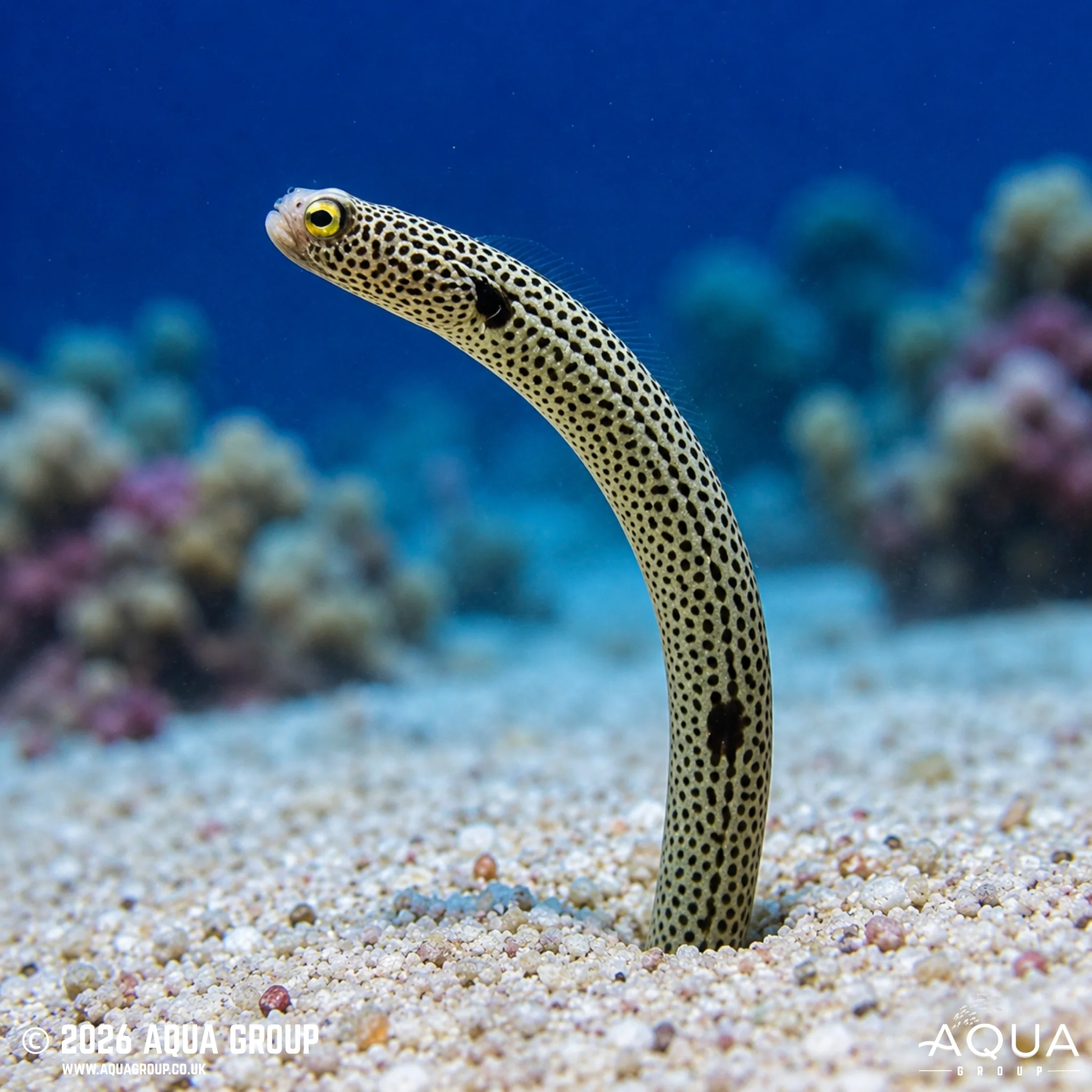
The Spotted Garden Eel, Heteroconger hassi, is a fascinating marine eel with a slender white body, black spotting and a unique burrow-dwelling lifestyle. Also known as Hass’s Garden Eel or the Spotted Garden-eel, this Indo-Pacific species lives in colonies on sandy reef slopes, with each eel anchored in its own burrow while facing into the current to catch passing zooplankton. It is peaceful and reef safe, but it is a specialist aquarium fish that requires a deep sand bed, frequent plankton-style feeding and a calm, species-appropriate setup.
Common Name:
Spotted Garden Eel, Spotted Garden-eel, Garden Eel, Hass’s Garden Eel.
Scientific Name (Latin):
Heteroconger hassi
Maximum Size:
Up to around 40 cm, though only part of the body is normally visible above the sand when settled.
Water Type:
Marine
Origin / Natural Habitat:
Indo-Pacific, from the Red Sea and East Africa across to the Society Islands, north to the Ryukyu and Ogasawara Islands, and south to north-western Australia and New Caledonia, including Micronesia. Naturally found on sandy slopes and reef-associated sand areas, often below 15 m, where colonies may contain dozens to several hundred individuals. Each eel lives in a vertical burrow and withdraws instantly when approached.
Water Parameters:
Temperature: 24–27°C
pH Range: 8.1–8.4
Hardness or Salinity: SG 1.023–1.025
Temperament:
Very peaceful and timid. Best kept with calm reef-safe fish that will not harass them, hover over the colony or outcompete them for suspended foods. Avoid predatory fish, aggressive wrasses, triggers, puffers, hawkfish, large dottybacks and boisterous tank mates.
Diet:
Planktivorous carnivore. In the wild, Spotted Garden Eels feed on zooplankton drifting past in the current. In the aquarium, offer frequent small feeds of enriched brineshrimp, copepods, cyclops, calanus, finely chopped mysis, rotifers, lobster eggs and other fine suspended marine foods. Food must be carried gently past the burrows, as garden eels rarely leave the sand to chase food.
Minimum Tank Size:
A minimum of 300 litres is recommended for a small group, with larger aquariums strongly preferred. Footprint and sand depth are more important than height. A deep, fine sand bed of at least 15–20 cm is recommended, with deeper areas preferred for long-term stability and natural burrowing.
Behaviour & Activity:
A specialist colony-forming eel that spends nearly all of its time with the rear body anchored in a sand burrow and the head and upper body extended into the water column. It faces into the current and picks tiny foods from the flow, retreating rapidly if startled. This species should be kept in groups where possible, as single specimens may be nervous and less natural in behaviour. Provide open sand, gentle laminar flow and a quiet viewing area away from constant disturbance.
Reef Safe:
Reef Safe
Safe with corals and most peaceful ornamental invertebrates. It does not nip corals or attack clean-up crew animals. The main reef concern is not coral compatibility, but providing a suitable deep sand zone and ensuring tank mates are calm enough for the eels to remain extended and feed properly.
Special Requirements or Care Notes:
Expert-level specialist species. Requires a deep fine sand bed, frequent small planktonic feeds, stable water quality and a tightly covered aquarium, as garden eels can jump when stressed or during acclimation. Do not keep in bare-bottom tanks, coarse gravel or shallow sand beds. Flow should deliver food past the burrows without blasting the eels directly. Newly introduced specimens may hide for extended periods and should be given a quiet, low-stress environment. Strong filtration is needed to manage the nutrient load from frequent feeding.
Suitable for:
Expert only
Availability:
Rare or occasional in trade
All images are a visual representation of the fish you will receive, made to be as accurate as possible. Please note that Mother Nature is a wonderful thing, and variation in patterns and colours will occur — that is part of the unique beauty of these animals.
Description
Spotted Garden Eel (Heteroconger hassi)
The Spotted Garden Eel, Heteroconger hassi, is a fascinating marine eel with a slender white body, black spotting and a unique burrow-dwelling lifestyle. Also known as Hass’s Garden Eel or the Spotted Garden-eel, this Indo-Pacific species lives in colonies on sandy reef slopes, with each eel anchored in its own burrow while facing into the current to catch passing zooplankton. It is peaceful and reef safe, but it is a specialist aquarium fish that requires a deep sand bed, frequent plankton-style feeding and a calm, species-appropriate setup.
Common Name:
Spotted Garden Eel, Spotted Garden-eel, Garden Eel, Hass’s Garden Eel.
Scientific Name (Latin):
Heteroconger hassi
Maximum Size:
Up to around 40 cm, though only part of the body is normally visible above the sand when settled.
Water Type:
Marine
Origin / Natural Habitat:
Indo-Pacific, from the Red Sea and East Africa across to the Society Islands, north to the Ryukyu and Ogasawara Islands, and south to north-western Australia and New Caledonia, including Micronesia. Naturally found on sandy slopes and reef-associated sand areas, often below 15 m, where colonies may contain dozens to several hundred individuals. Each eel lives in a vertical burrow and withdraws instantly when approached.
Water Parameters:
Temperature: 24–27°C
pH Range: 8.1–8.4
Hardness or Salinity: SG 1.023–1.025
Temperament:
Very peaceful and timid. Best kept with calm reef-safe fish that will not harass them, hover over the colony or outcompete them for suspended foods. Avoid predatory fish, aggressive wrasses, triggers, puffers, hawkfish, large dottybacks and boisterous tank mates.
Diet:
Planktivorous carnivore. In the wild, Spotted Garden Eels feed on zooplankton drifting past in the current. In the aquarium, offer frequent small feeds of enriched brineshrimp, copepods, cyclops, calanus, finely chopped mysis, rotifers, lobster eggs and other fine suspended marine foods. Food must be carried gently past the burrows, as garden eels rarely leave the sand to chase food.
Minimum Tank Size:
A minimum of 300 litres is recommended for a small group, with larger aquariums strongly preferred. Footprint and sand depth are more important than height. A deep, fine sand bed of at least 15–20 cm is recommended, with deeper areas preferred for long-term stability and natural burrowing.
Behaviour & Activity:
A specialist colony-forming eel that spends nearly all of its time with the rear body anchored in a sand burrow and the head and upper body extended into the water column. It faces into the current and picks tiny foods from the flow, retreating rapidly if startled. This species should be kept in groups where possible, as single specimens may be nervous and less natural in behaviour. Provide open sand, gentle laminar flow and a quiet viewing area away from constant disturbance.
Reef Safe:
Reef Safe
Safe with corals and most peaceful ornamental invertebrates. It does not nip corals or attack clean-up crew animals. The main reef concern is not coral compatibility, but providing a suitable deep sand zone and ensuring tank mates are calm enough for the eels to remain extended and feed properly.
Special Requirements or Care Notes:
Expert-level specialist species. Requires a deep fine sand bed, frequent small planktonic feeds, stable water quality and a tightly covered aquarium, as garden eels can jump when stressed or during acclimation. Do not keep in bare-bottom tanks, coarse gravel or shallow sand beds. Flow should deliver food past the burrows without blasting the eels directly. Newly introduced specimens may hide for extended periods and should be given a quiet, low-stress environment. Strong filtration is needed to manage the nutrient load from frequent feeding.
Suitable for:
Expert only
Availability:
Rare or occasional in trade
All images are a visual representation of the fish you will receive, made to be as accurate as possible. Please note that Mother Nature is a wonderful thing, and variation in patterns and colours will occur — that is part of the unique beauty of these animals.