The Story
Spineless Tuxedo Urchin (Mespilia globulus)
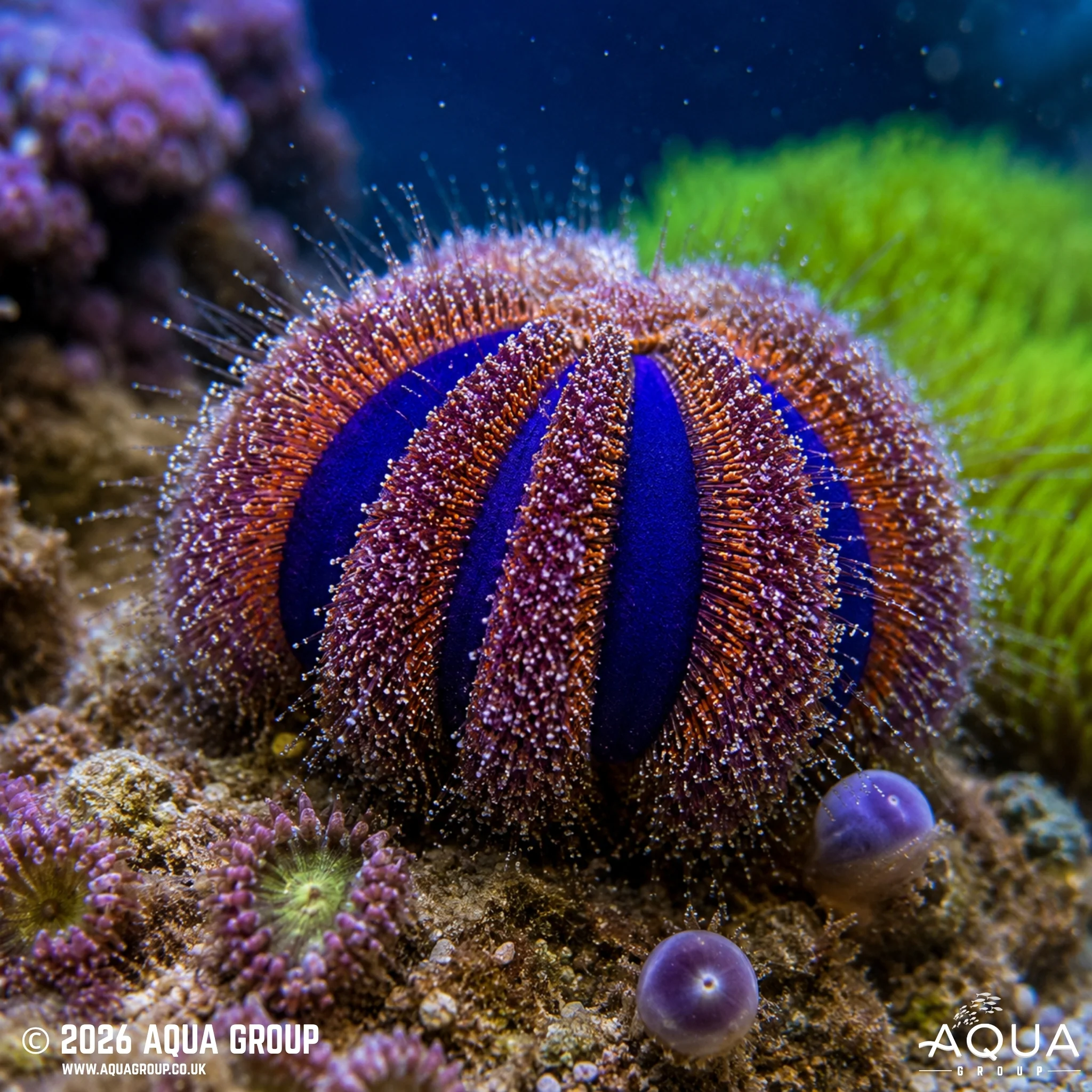
The Spineless Tuxedo Urchin, Mespilia globulus, is a compact and attractive marine algae-grazing urchin with a rounded body, short neat spines and striking blue, black, red, brown or green banding depending on the individual. Also known as the Tuxedo Urchin, Blue Tuxedo Urchin, Globular Sea Urchin or Sphere Sea Urchin, this Indo-Pacific invertebrate is a popular reef aquarium grazer for mature systems. It is peaceful and reef safe, but should be kept in stable aquariums with enough algae or supplemental seaweed to prevent starvation.
Common Name:
Spineless Tuxedo Urchin, Tuxedo Urchin, Blue Tuxedo Urchin, Globular Sea Urchin, Sphere Sea Urchin, Collector Urchin.
Scientific Name (Latin):
Mespilia globulus
Maximum Size:
Usually up to around 5 cm test diameter, not including the short spines.
Water Type:
Marine
Origin / Natural Habitat:
Indo-Pacific. Naturally found in shallow reef areas, coral rubble and seagrass beds from very shallow water down to around 60 m. It moves over hard surfaces, rubble and reef structure while grazing and may attach small pieces of debris, shell, algae or loose material to its body for camouflage.
Water Parameters:
Temperature: 24–27°C
pH Range: 8.1–8.4
Hardness or Salinity: SG 1.023–1.025
Temperament:
Peaceful. It will not attack fish, corals or mobile invertebrates, but it may accidentally carry or dislodge loose frags, small shells, algae pieces or unsecured decorations while moving around the aquarium.
Diet:
Herbivorous grazer and detrital film feeder. In the aquarium, it feeds on microalgae, film algae, green algae, some nuisance algae, coralline algae and natural surface films on rockwork and glass. In very clean or newer aquariums, supplement with dried seaweed, nori, algae wafers or suitable marine herbivore foods placed near the urchin.
Minimum Tank Size:
A minimum of 100 litres is recommended for a single specimen, with larger mature aquariums preferred. The key requirement is a stable system with enough established grazing surfaces rather than just tank volume.
Behaviour & Activity:
A slow-moving reef grazer that spends its time travelling across live rock, glass, rubble and aquarium surfaces in search of algae and biofilm. It is often more active at night or during quieter periods. Like many collector-type urchins, it may pick up small loose objects and carry them on its body, so coral frags should be securely fixed before adding it.
Reef Safe:
Reef Safe
Generally safe with corals, snails, hermit crabs, cleaner shrimps and most peaceful reef inhabitants. It does not eat coral tissue, but may knock over loose coral frags, carry small items around the aquarium or graze coralline algae from rockwork. Avoid keeping with urchin-eating predators such as some triggers, puffers, large wrasses and certain crabs.
Special Requirements or Care Notes:
Requires stable salinity, good water quality and slow acclimation. Like other echinoderms, it is sensitive to copper, sudden salinity changes, poor acclimation and high nitrate levels. Spine loss, poor grip or inactivity can indicate stress, starvation or declining water quality. Do not add to a new, sterile aquarium with little algae growth. Secure loose coral frags and protect the urchin from predatory fish or crabs.
Suitable for:
Beginner to intermediate fishkeepers
Availability:
Common in trade / Captive-bred where relevant
All images are a visual representation of the animal you will receive, made to be as accurate as possible. Please note that Mother Nature is a wonderful thing, and variation in patterns and colours will occur — that is part of the unique beauty of these animals.
Description
Spineless Tuxedo Urchin (Mespilia globulus)
The Spineless Tuxedo Urchin, Mespilia globulus, is a compact and attractive marine algae-grazing urchin with a rounded body, short neat spines and striking blue, black, red, brown or green banding depending on the individual. Also known as the Tuxedo Urchin, Blue Tuxedo Urchin, Globular Sea Urchin or Sphere Sea Urchin, this Indo-Pacific invertebrate is a popular reef aquarium grazer for mature systems. It is peaceful and reef safe, but should be kept in stable aquariums with enough algae or supplemental seaweed to prevent starvation.
Common Name:
Spineless Tuxedo Urchin, Tuxedo Urchin, Blue Tuxedo Urchin, Globular Sea Urchin, Sphere Sea Urchin, Collector Urchin.
Scientific Name (Latin):
Mespilia globulus
Maximum Size:
Usually up to around 5 cm test diameter, not including the short spines.
Water Type:
Marine
Origin / Natural Habitat:
Indo-Pacific. Naturally found in shallow reef areas, coral rubble and seagrass beds from very shallow water down to around 60 m. It moves over hard surfaces, rubble and reef structure while grazing and may attach small pieces of debris, shell, algae or loose material to its body for camouflage.
Water Parameters:
Temperature: 24–27°C
pH Range: 8.1–8.4
Hardness or Salinity: SG 1.023–1.025
Temperament:
Peaceful. It will not attack fish, corals or mobile invertebrates, but it may accidentally carry or dislodge loose frags, small shells, algae pieces or unsecured decorations while moving around the aquarium.
Diet:
Herbivorous grazer and detrital film feeder. In the aquarium, it feeds on microalgae, film algae, green algae, some nuisance algae, coralline algae and natural surface films on rockwork and glass. In very clean or newer aquariums, supplement with dried seaweed, nori, algae wafers or suitable marine herbivore foods placed near the urchin.
Minimum Tank Size:
A minimum of 100 litres is recommended for a single specimen, with larger mature aquariums preferred. The key requirement is a stable system with enough established grazing surfaces rather than just tank volume.
Behaviour & Activity:
A slow-moving reef grazer that spends its time travelling across live rock, glass, rubble and aquarium surfaces in search of algae and biofilm. It is often more active at night or during quieter periods. Like many collector-type urchins, it may pick up small loose objects and carry them on its body, so coral frags should be securely fixed before adding it.
Reef Safe:
Reef Safe
Generally safe with corals, snails, hermit crabs, cleaner shrimps and most peaceful reef inhabitants. It does not eat coral tissue, but may knock over loose coral frags, carry small items around the aquarium or graze coralline algae from rockwork. Avoid keeping with urchin-eating predators such as some triggers, puffers, large wrasses and certain crabs.
Special Requirements or Care Notes:
Requires stable salinity, good water quality and slow acclimation. Like other echinoderms, it is sensitive to copper, sudden salinity changes, poor acclimation and high nitrate levels. Spine loss, poor grip or inactivity can indicate stress, starvation or declining water quality. Do not add to a new, sterile aquarium with little algae growth. Secure loose coral frags and protect the urchin from predatory fish or crabs.
Suitable for:
Beginner to intermediate fishkeepers
Availability:
Common in trade / Captive-bred where relevant
All images are a visual representation of the animal you will receive, made to be as accurate as possible. Please note that Mother Nature is a wonderful thing, and variation in patterns and colours will occur — that is part of the unique beauty of these animals.